
Introduction
The best Google Analytics alternatives are not all designed for the same job. Matomo is one of the closest broad replacements for GA4. Plausible and Fathom offer simpler, privacy-focused website reporting. Amplitude, Mixpanel and PostHog help product teams study funnels, retention and feature adoption. Meanwhile, Microsoft Clarity adds heatmaps and session recordings.
For most website owners, the right choice depends on whether they value reporting depth, ease of use, privacy, product analytics or competitor research.
This comparison examines nine leading alternatives to Google Analytics in 2026. It covers their strengths, limitations, hosting models, free options and ideal users. It also explains why Semrush and Similarweb are useful analytics tools but not direct GA4 replacements, and how Adobe's analytics offering fits enterprise needs.
Best Google Analytics Alternatives at a Glance
Before choosing a platform, identify what you expect it to replace. A simple web analytics tool may report page views, sources and popular content but lack GA4's advertising integrations. A product analytics platform may offer excellent funnels while providing less traditional SEO and acquisition reporting.
The table below separates the tools by their main purpose.
| Tool | Best for | Primary analytics type | Free option | Hosting | GA4 replacement level |
|---|---|---|---|---|---|
| Matomo | Broad website analytics | Web and marketing analytics | Free self-hosted edition | Cloud or self-hosted | Strong |
| Plausible | Simple privacy-focused reporting | Web analytics | Free self-hosted Community Edition | Cloud or self-hosted | Partial to strong |
| Fathom Analytics | Managed privacy-first analytics | Web analytics | Free trial | Managed cloud | Partial |
| Piwik PRO | Regulated and larger organisations | Web analytics and data activation | Free trial | Managed deployment options | Strong |
| Umami | Lightweight open-source reporting | Web analytics | Free cloud tier and self-hosting | Cloud or self-hosted | Partial |
| Amplitude | SaaS and digital products | Product analytics | Free plan | Cloud | Specialised |
| Mixpanel | Funnels, retention and engagement | Product and web analytics | Free plan | Cloud | Specialised |
| PostHog | Product engineering teams | Product analytics and experimentation | Free monthly allowances | Cloud or self-hosted | Specialised |
| Microsoft Clarity | Heatmaps and session recordings | Behaviour analytics | Free | Cloud | Companion tool |
"GA4 replacement level" does not mean that a platform reproduces every Google Analytics feature. It indicates whether the tool can replace GA4's main function for its intended audience.
Matomo provides cloud and free on-premise options, while Plausible and Umami also support self-hosting. Amplitude, Mixpanel and PostHog offer meaningful free usage allowances, and Microsoft describes Clarity as free forever with no traffic limit. Plan terms can change, so always confirm the latest limits before migrating.

What Counts as a Google Analytics Alternative?
Google Analytics collects event-based data from websites and apps. It can report traffic acquisition, user activity, events, key events and ecommerce behaviour when tracking has been configured correctly.
Therefore, a direct Google Analytics alternative should usually answer questions such as:
- How many people visited the website?
- Which pages did they view?
- Where did the traffic come from?
- Which campaigns produced visits or conversions?
- What actions did visitors complete?
- Which landing pages performed well?
- How did behaviour differ by device, location or source?
Web analytics
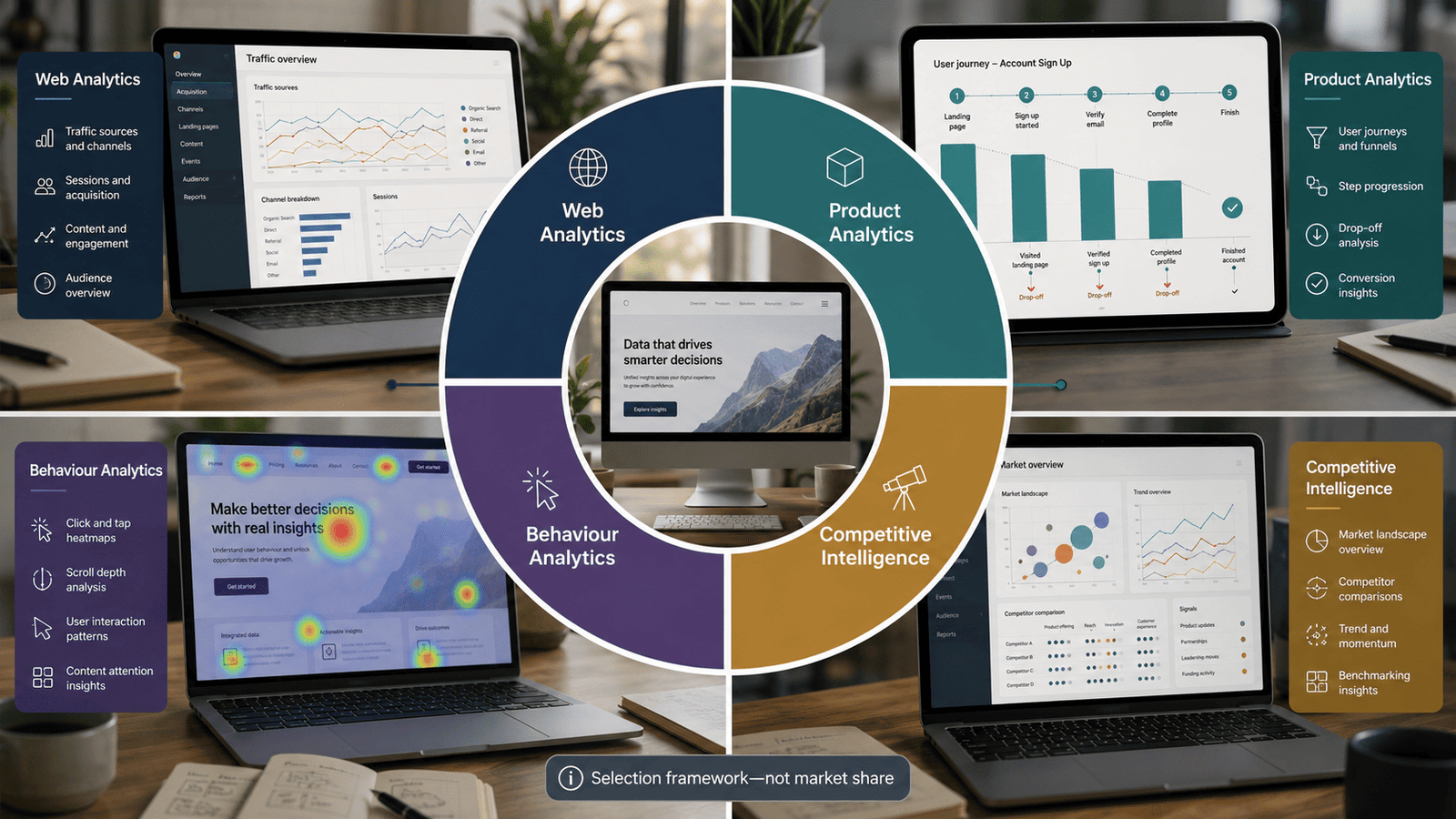
Web analytics platforms measure visits, page views, traffic sources, landing pages, campaigns and website conversions. Matomo, Plausible, Fathom, Piwik PRO and Umami belong mainly to this category.
Product analytics
Product analytics focuses on what identified or anonymous users do inside an app, SaaS platform or digital product. Common reports include event funnels, retention, feature adoption, user paths and behavioural cohorts.
Amplitude, Mixpanel and PostHog are stronger in this area. They may track websites, but their main value appears when a business needs to understand a series of product actions rather than only sessions and page views.
Behaviour analytics
Behaviour analytics tools show how visitors interact with a page. Heatmaps may reveal where people click or how far they scroll. Session recordings recreate a visitor's journey through the interface.
Microsoft Clarity specialises in this type of analysis. It can complement GA4 or another web analytics platform, but it does not replace every acquisition, campaign and conversion report.
Competitive intelligence
Semrush and Similarweb estimate activity on websites you do not control. This supports competitor research, market analysis and traffic benchmarking.
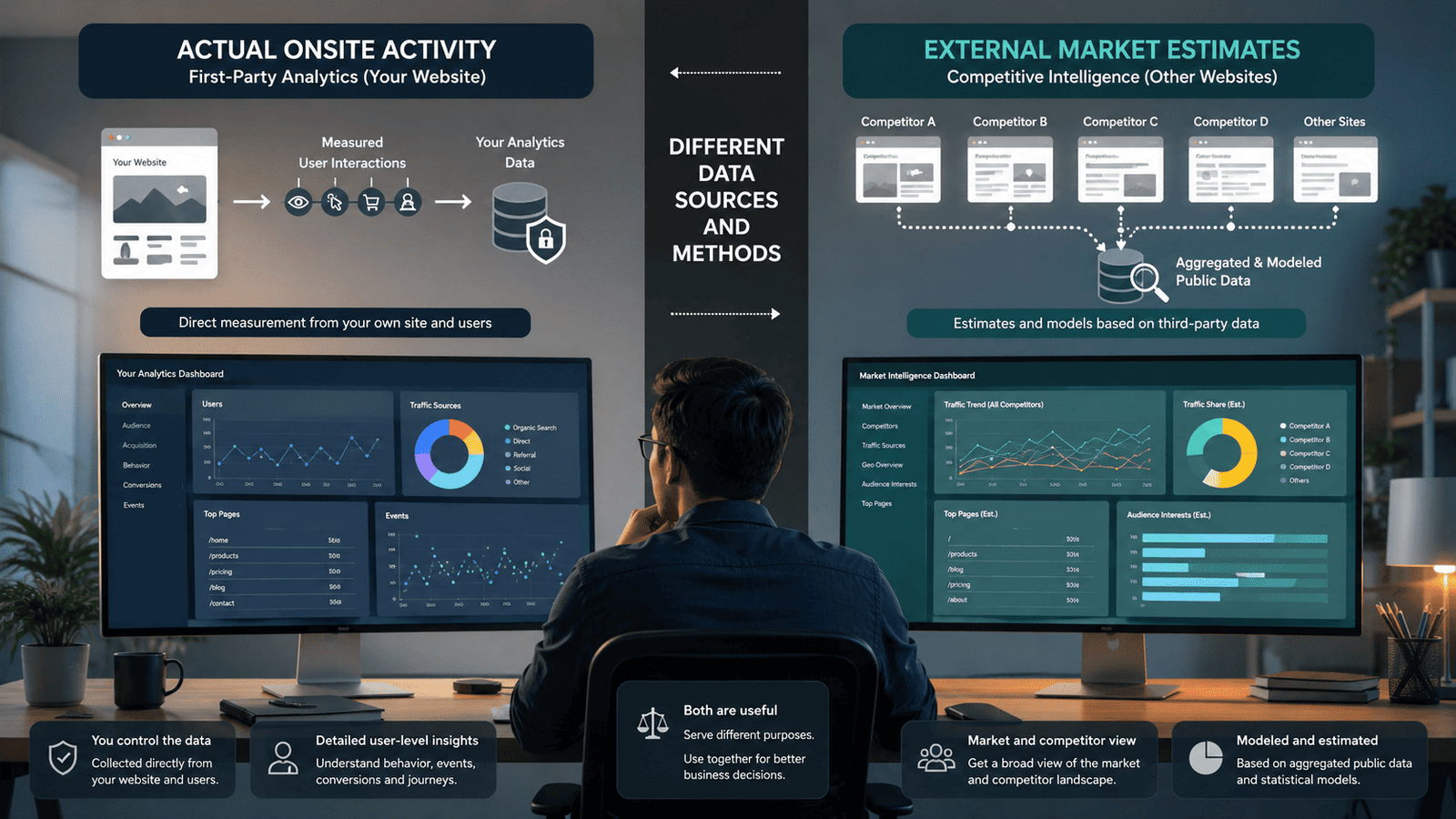
They are not equivalent to first-party analytics installed on your own site. A direct measurement platform records activity through your tracking setup, while competitive intelligence platforms rely on modelling, external datasets and estimation methods.
Why Businesses Look for Alternatives to Google Analytics
Google Analytics remains useful, particularly for businesses that rely on Google Ads, Google Tag Manager and other Google products. It is also available at no cost for standard website and app measurement. Website owners unfamiliar with its basic reports can start with a Google Analytics beginner's guide before deciding whether migration is necessary.
Still, several valid reasons may lead a business to consider alternatives to Google Analytics.
Simpler reporting
Many content websites, professional services firms and small businesses do not need a large collection of configurable reports.
They may only need to know:
- Which pages attract traffic
- Where visitors come from
- Which campaigns work
- How many visitors complete an enquiry
- Which content is growing or declining
A focused dashboard can make those answers easier to find. However, simpler reporting usually means fewer options for advanced segmentation, attribution and custom exploration.
Privacy and data control
Some organisations want cookieless measurement, EU-based processing, self-hosting or greater control over data retention.
Privacy-focused tools can reduce unnecessary data collection. However, no analytics product automatically makes an entire website compliant with every privacy law.
Self-hosting requirements
A self-hosted platform keeps the analytics application and its data on infrastructure controlled by the organisation.
This may suit teams with strict hosting requirements. On the other hand, self-hosting creates responsibility for updates, security, backups, uptime, storage and performance.
Better product analysis
GA4 uses an event-based data model and supports funnels through Explorations. Even so, product teams may prefer platforms built around retention, feature usage, cohorts, experimentation and detailed behavioural journeys.
Heatmaps and recordings
GA4 can show that a landing page has a weak conversion rate. It cannot always show where people hesitated, repeatedly clicked or abandoned a form.
Session replay and heatmap tools help investigate the experience behind the numbers. They work best alongside a web or product analytics platform rather than as the only measurement system.

How These Analytics Platforms Were Compared
This article does not assign arbitrary scores. A platform can be excellent for a product team and unsuitable for a small publishing website.
Instead, each tool was assessed using practical selection criteria:
- Primary use case
- Reporting depth
- Ease of use
- Privacy controls
- Cookie and consent options
- Cloud or self-hosted availability
- Event and conversion tracking
- Funnel and retention analysis
- Heatmaps and session replay
- Data ownership and export
- Free plans or trials
- Pricing model
- Technical maintenance
- Suitability for small or large organisations
- Ability to replace GA4's main role
The Best Google Analytics Alternatives for 2026
Matomo: Best Google Analytics Alternative Overall
Matomo is one of the closest options for organisations seeking a broad Google Analytics alternative rather than a narrow traffic counter.
It covers traditional web analytics such as visitors, pages, sources, campaigns, events and goals. Depending on the hosting plan and extensions selected, Matomo can also support ecommerce analysis, funnels, heatmaps, session recordings and other advanced functions.
Best for: Businesses seeking detailed website analytics, data ownership or a self-hosted GA4 replacement.
Strengths:
- Broad web and marketing analytics
- Cloud and self-hosted deployment
- Free Community edition
- Raw data access and export options
- Suitable for content, lead-generation and ecommerce sites
- More familiar to users who prefer traditional website reports
Limitations:
- Self-hosting requires technical maintenance
- Some advanced features may require paid add-ons or a cloud plan
- The interface can still feel complex for users wanting only basic traffic figures
- Migration and event configuration need planning
Verdict: Matomo is the strongest all-round choice when a business needs more than a lightweight dashboard but wants greater control over hosting and data.
Plausible Analytics: Best for Simple Reporting
Plausible Analytics removes much of the reporting complexity associated with larger analytics suites.
Best for: Content sites, small businesses and teams seeking a clear privacy-focused dashboard.
Strengths:
- Easy-to-scan reporting
- Cookie-free measurement model
- Cloud and self-hosted options
- Events, goals and campaign tracking
- Google Analytics data import
- No per-seat pricing on hosted plans
Limitations:
- Less suitable for complex product analytics
- Fewer advanced explorations than GA4 or Matomo
- The managed service is not a free hosted replacement
- Self-hosting requires server administration
Verdict: Plausible is a strong Google Analytics alternative when simplicity is more valuable than deep attribution, advertising integration or complex audience analysis.
Fathom Analytics: Best Managed Privacy-First Option
Best for: Agencies, consultants and businesses wanting managed analytics across several websites.
Strengths:
- Clean and accessible dashboard
- Managed infrastructure
- Multiple websites supported
- Event and ecommerce tracking
- API access
- Privacy-focused data collection
Limitations:
- No free-forever hosted tier
- Less reporting depth than enterprise analytics platforms
- Not intended for advanced product-retention analysis
- Businesses with very high traffic must account for volume-based pricing
Verdict: Fathom is a practical option for organisations that prefer a paid, managed service and do not want to maintain a self-hosted analytics platform.

Piwik PRO: Best for Regulated Organisations
Best for: Larger businesses and regulated organisations requiring governance, privacy controls and enterprise support.
Strengths:
- Detailed web analytics
- Custom reports and dashboards
- Options for cookie-based or cookie-free collection
- Data-activation capabilities
- Enterprise governance and support
- Designed for sensitive or regulated use cases
Limitations:
- More platform than a basic website may need
- Pricing requires closer evaluation than simple fixed-price tools
- Implementation can involve legal, marketing and technical stakeholders
- May be excessive for a small blog or brochure website
Verdict: Piwik PRO is one of the stronger alternatives to Google Analytics for organisations that need analytics depth without treating privacy and governance as secondary concerns.
Umami: Best Lightweight Self-Hosted Alternative
Best for: Developers, small SaaS teams and businesses wanting lightweight open-source analytics.
Strengths:
- Open-source platform
- Free self-hosting
- Cookie-free reporting
- Simple interface
- Lightweight script
- Cloud option for teams that do not want server management
Limitations:
- Narrower reporting than Matomo or GA4
- Self-hosting still involves infrastructure work
- Limited fit for complex attribution and advertising analysis
- Not designed for deep enterprise customer-journey reporting
Verdict: Umami is a strong choice for technically comfortable teams that want straightforward ownership and do not require a large marketing analytics suite.
Amplitude: Best for Product-Led Companies
Best for: SaaS platforms, mobile apps and businesses that measure activation, engagement and retention.
Strengths:
- Strong funnels and retention analysis
- Product-focused event tracking
- Behavioural cohorts
- Session replay and experimentation tools
- Generous free event allowance
- Useful for web and app products
Limitations:
- More implementation work than a basic page-view tool
- Requires a clear event-tracking plan
- Can be excessive for a simple publishing site
- Does not replace every SEO, campaign or Google Ads workflow
Verdict: Amplitude is one of the best Google Analytics alternatives for product teams, but it should be selected for product behaviour rather than merely to obtain simpler website traffic reports.
Mixpanel: Best for Funnels and Retention
Best for: Product and growth teams that need accessible funnels, cohorts and retention reports.
Strengths:
- Strong event-based analysis
- Funnel and retention reporting
- Web and product analytics
- Session replay
- Free entry plan
- Suitable for non-technical product managers after setup
Limitations:
- Event planning and data governance remain necessary
- Free-plan report limits may affect active teams
- Not a full substitute for every advertising or acquisition report in GA4
- Usage-based costs should be modelled as event volume grows
Verdict: Mixpanel works best when the central question is not only "Where did visitors come from?" but also "Which actions led them to remain, convert or leave?"

PostHog: Best for Product Engineering Teams
Best for: Startups and product-engineering teams wanting analytics, replay, flags and experimentation together.
Strengths:
- Broad product-development suite
- Product and web analytics
- Session replay
- Feature flags and experiments
- Usage-based free allowances
- Open-source self-hosting option
Limitations:
- Wider scope creates more complexity
- Not necessary for a basic content website
- Self-hosted operation can be technically demanding
- Each product has its own usage and pricing considerations
Verdict: PostHog is compelling for technical product organisations. It is less suitable for a business that only needs a weekly traffic report.
Microsoft Clarity: Best Free Heatmap Tool
Best for: Website owners seeking free heatmaps, recordings and usability evidence.
Strengths:
- Free service
- No stated traffic limit
- Heatmaps
- Session recordings
- Useful visual evidence
- WordPress integration available
Limitations:
- Not a full marketing analytics replacement
- Limited traditional acquisition and attribution reporting
- Recordings require careful privacy review
- Large volumes of recordings can consume analysis time
Verdict: Microsoft Clarity should usually complement Matomo, Plausible, GA4 or another analytics platform rather than replace them.
Semrush vs Google Analytics
Semrush and Google Analytics answer different questions.
Google Analytics measures activity on a website or app where tracking has been installed. Semrush estimates the visibility and performance of websites across search and other external datasets.
The two platforms are therefore complementary.
Similarweb vs Google Analytics
Similarweb also focuses heavily on external digital intelligence.
Use Similarweb for competitor and market context. Use GA4 or another first-party analytics platform to measure activity on your own website.
Adobe Analytics vs Google Analytics
In a November 2025 explainer, Adobe stated that Adobe Analytics was no longer sold to new customers and directed readers toward Adobe Customer Journey Analytics for behavioural analytics.
Which Google Analytics Alternative Should You Choose?
| Your main priority | Recommended shortlist |
|---|---|
| Closest broad GA4 replacement | Matomo or Piwik PRO |
| Simple website reporting | Plausible or Fathom |
| Free self-hosted web analytics | Matomo Community or Umami |
| Privacy-focused managed service | Plausible or Fathom |
| SaaS product analytics | Amplitude or Mixpanel |
| Product analytics plus engineering tools | PostHog |
| Free heatmaps and recordings | Microsoft Clarity |
| Competitor SEO research | Semrush |
| Competitor traffic and market research | Similarweb |
| Cross-channel enterprise analytics | Adobe Customer Journey Analytics |

Free SEO Tools to Pair with Your Analytics
Whichever analytics platform you choose, make sure your SEO fundamentals are covered. Browse our full collection of free SEO tools including the SEO Title Analyzer for optimizing click-through rates, the Schema Markup Generator for structured data, and the Page Indexability Checker to verify your pages are discoverable. For content quality, try the Reading Level Analyzer and Overused Words Finder. Optimize your social sharing images with the Social Media Image Resizer.
Conclusion
The best Google Analytics alternatives solve different measurement problems. Matomo and Piwik PRO are the strongest broad replacements. Plausible, Fathom and Umami reduce reporting complexity. Amplitude, Mixpanel and PostHog serve product-led teams, while Microsoft Clarity adds valuable visual behaviour analysis.
The most reliable choice is the platform that preserves the reports and actions your business genuinely uses -- not the tool with the longest feature list.
Begin by auditing the current GA4 setup. Then shortlist two suitable platforms and test them alongside the existing implementation. Compare events, campaigns, conversions, privacy settings and future costs before making the final switch.

Frequently Asked Questions
What is the best alternative to Google Analytics?
Matomo is one of the best broad alternatives because it supports detailed web analytics, cloud hosting and free self-hosting. Plausible or Fathom may be better for simpler reporting, while Amplitude and Mixpanel are stronger for product analytics.
Is there a free Google Analytics alternative?
Yes. Matomo Community Edition and Umami can be self-hosted for free, although hosting and maintenance may still cost money. Amplitude, Mixpanel and PostHog offer free usage allowances. Microsoft Clarity provides free heatmaps and session recordings.
Can Matomo completely replace Google Analytics?
Matomo can replace the main website-analytics role of GA4 for many organisations. However, businesses relying on Google Ads audiences, specific attribution workflows, Firebase, BigQuery or other Google integrations should review those dependencies before migrating.
What is the easiest Google Analytics alternative?
Plausible and Fathom are among the easiest options for website owners who need traffic, source, content and goal reporting.
Which Google Analytics alternative is best for WordPress?
Plausible, Matomo, Fathom, Umami and Microsoft Clarity can all be used with WordPress.
Are privacy-friendly analytics tools automatically GDPR-compliant?
No tool can guarantee that an entire website is compliant in every situation.
Is Microsoft Clarity a replacement for Google Analytics?
Not usually. Clarity focuses on heatmaps and session recordings.
Is Semrush better than Google Analytics?
Neither tool is universally better because they measure different things.
Is Similarweb more accurate than Google Analytics?
For your own website, a correctly configured first-party platform such as Google Analytics records direct measurement data.
Which Google Analytics alternative is best for SaaS?
Amplitude and Mixpanel are strong options for SaaS businesses focused on activation, engagement, funnels and retention.
Can historical Google Analytics data be transferred?
Some platforms can import selected historical Google Analytics data.
Should I remove Google Analytics immediately after installing an alternative?
No. Run both systems in parallel until events, campaigns, conversions, internal-traffic filters and ecommerce data have been checked.